Harley Torque Specs PDF: A Comprehensive Guide
Harley-Davidson offers readily available torque specification booklets (Part No: 99959-14) and online charts, simplifying maintenance and repair procedures for enthusiasts.
Harley-Davidson motorcycle maintenance hinges on precise torque application to fasteners. Utilizing correct torque values ensures component integrity, optimal performance, and rider safety. Harley provides comprehensive torque specifications through dedicated resources like service manuals and the convenient Ready Reference Torque Value booklets (99959-14).
These resources eliminate guesswork, preventing under-tightening, which can lead to loosening and failure, or over-tightening, potentially damaging threads or components. Understanding these specifications is crucial for both professional mechanics and DIY enthusiasts maintaining their machines. Accessing these PDFs streamlines the process, offering readily available data for various models and components.
Why Use a Torque Specs PDF for Harley-Davidson?
A Harley-Davidson torque specs PDF provides instant access to critical fastener values, eliminating the need to search through bulky service manuals. These digital resources offer convenience and portability, allowing technicians and owners to quickly reference specifications during maintenance or repairs; The Ready Reference booklets, available in PDF format, consolidate popular torque values for common tasks.
Having a PDF ensures you always have the correct information at your fingertips, reducing errors and promoting accurate assembly. This is particularly useful when working remotely or lacking access to a physical workshop. Reliable sources offer downloadable PDFs, streamlining the maintenance process and enhancing the overall ownership experience.
Understanding Harley Torque Values
Harley-Davidson torque values are crucial for proper assembly, impacting performance and safety; accurate torque prevents component failure and ensures optimal motorcycle function.
Importance of Accurate Torque
Applying the correct torque to fasteners on a Harley-Davidson motorcycle is paramount for several reasons. Under-torquing can lead to components loosening over time, potentially causing vibrations, noise, and ultimately, mechanical failure. Conversely, over-torquing can stretch or break bolts, strip threads, and damage the parts being fastened.
Precise torque ensures proper clamping force, maintaining the integrity of joints and preventing leaks, especially critical in engine and brake systems. Utilizing a Harley-Davidson torque specs PDF or reference guide guarantees adherence to manufacturer recommendations, safeguarding reliability and extending the lifespan of your motorcycle. Ignoring these specifications compromises safety and performance.
Factors Affecting Torque Specifications
Several factors influence the specified torque values for Harley-Davidson fasteners. Bolt size, thread pitch, and material composition are primary considerations. The presence of lubricants, such as oil or anti-seize compounds, significantly alters friction and necessitates adjusted torque settings – often requiring a reduction in applied force.
Furthermore, the type of fastener (e.g., grade 5, grade 8) dictates its strength and appropriate torque range. Environmental conditions and the intended application also play a role. Consulting a Harley-Davidson torque specs PDF ensures you account for these variables, guaranteeing a secure and reliable assembly.
Units of Measurement (ft-lbs, Nm, in-lbs)
Harley-Davidson torque specifications are commonly presented in three primary units: foot-pounds (ft-lbs), Newton-meters (Nm), and inch-pounds (in-lbs). Foot-pounds are typically used for larger fasteners like axle nuts and engine components, while Newton-meters are prevalent in metric systems and increasingly found in modern documentation.
Inch-pounds are reserved for smaller bolts and screws, ensuring precise tightening without damage. A reliable torque specs PDF will clearly indicate the unit used for each fastener. Accurate conversion between these units is crucial for avoiding over or under-tightening, maintaining component integrity and safety.

Locating Harley Torque Specs
Harley-Davidson torque specs are found in service manuals, ready reference booklets (99959-14), and conveniently accessible online charts and databases.
Harley-Davidson Service Manuals
Harley-Davidson service manuals represent the most comprehensive source for accurate torque specifications. These manuals, specific to each motorcycle model and year, detail every bolt and fastener’s precise tightening requirements. They provide detailed diagrams and step-by-step instructions, ensuring correct assembly and preventing potential damage.
Accessing the correct manual is crucial; using a manual for a different model can lead to incorrect torque values. While a significant investment, the service manual offers peace of mind and safeguards against costly errors. Digging through the manual is sometimes necessary, but it’s the most reliable method for finding the correct torque values.
Ready Reference Torque Value Booklets (Part No: 99959-14)
Harley-Davidson’s Ready Reference Torque Value booklets (Part No: 99959-14) offer a convenient alternative to full service manuals. These booklets compile popular torque values into a compact, easily accessible format, streamlining maintenance tasks. They allow quick lookups without extensive searching through larger manuals.
However, these booklets may not cover every fastener on every model. It’s essential to verify the booklet’s applicability to your specific motorcycle year and model. These are a great tool for regular maintenance, but the service manual remains the definitive source for complete and accurate specifications.
Online Torque Charts and Databases
Numerous online resources provide Harley-Davidson torque specifications, offering accessibility beyond physical manuals. These charts and databases often categorize values by engine type, component, or bolt size, facilitating quick searches. However, exercise caution when using online sources; verify information against official Harley-Davidson documentation whenever possible.
Cross-reference data from multiple sources to ensure accuracy; Some forums and enthusiast websites compile torque specs, but their reliability can vary. Prioritize official Harley-Davidson resources or reputable aftermarket suppliers for the most dependable information, safeguarding against potential damage from incorrect torque values.

Specific Harley-Davidson Engine Torque Specs
Harley-Davidson engine torque specifications vary significantly by model, encompassing Evolution, Twin Cam, and Milwaukee-Eight engines, each requiring precise fastener tightening.
Evolution Engines (1340cc, 1450cc, 1584cc)
Harley-Davidson Evolution engines, spanning 1340cc, 1450cc, and 1584cc displacements, necessitate meticulous torque application for optimal performance and longevity. Accessing accurate specifications is crucial, often found within dedicated service manuals or the readily available Ready Reference Torque Value booklets (Part No: 99959-14).
These resources detail precise values for critical components like the crank pin nut and pinion gear. Discrepancies can sometimes occur between manuals; when in doubt, referencing the higher specified torque value is a prudent approach to ensure secure fastening. Utilizing a calibrated torque wrench is paramount for achieving these specifications consistently, preventing both under-tightening and the risk of damaging threads through over-torquing.
Twin Cam Engines (88ci, 95ci, 103ci, 110ci, 117ci)
Harley-Davidson Twin Cam engines, ranging from 88ci to 117ci, demand precise torque specifications for reliable operation. The official service manuals and the convenient Ready Reference Torque Value booklets (Part No: 99959-14) are essential resources for locating these values. These documents provide detailed torque figures for all critical engine components, ensuring proper assembly and preventing potential failures.
When encountering conflicting values, prioritizing the higher specification is a recommended safety measure. Employing a calibrated torque wrench is vital for accurate application, safeguarding against both insufficient and excessive tightening, which could compromise engine integrity and performance.
Milwaukee-Eight Engines (107ci, 114ci, 117ci, 128ci)
Harley-Davidson’s Milwaukee-Eight engines, spanning 107ci to 128ci, necessitate strict adherence to specified torque values. Accessing accurate specifications is crucial, and the official service manuals alongside the Ready Reference Torque Value booklets (Part No: 99959-14) are invaluable tools. These resources detail torque requirements for every engine component, guaranteeing optimal performance and longevity.
Should discrepancies arise between manuals, adopting the higher torque value is a prudent approach. Utilizing a properly calibrated torque wrench is paramount for precise tightening, preventing damage and ensuring a secure, reliable engine build.
Crank Pin Nut Torque Specifications
Harley-Davidson crank pin nut torque specifications are critically important for engine assembly and reliability. Technical information regarding these values can be found within official service manuals and the Ready Reference Torque Value booklets (Part No: 99959-14). These documents provide precise figures, ensuring proper clamping force and preventing potential crankshaft issues.
Always consult the correct specification for your specific engine model, as values vary. Employing a calibrated torque wrench is essential for accurate application, safeguarding against under- or over-tightening, both detrimental to engine health.
Pinion Gear Torque Specifications
Harley-Davidson pinion gear torque specifications are vital for proper transmission function and longevity. Accurate torque application prevents premature wear and ensures smooth operation. Refer to the official Harley-Davidson service manuals or the Ready Reference Torque Value booklets (Part No: 99959-14) for precise values specific to your motorcycle model and year.
These resources detail the correct torque sequence and values for pinion gear installation. Utilizing a calibrated torque wrench is paramount to avoid damage or failure. Always double-check specifications before tightening.

Torque Specifications for Common Harley Components
Harley component torque values, like those for sprocket screws and brake bleeders, are detailed in service manuals and the 99959-14 torque booklet.
Bolt Sprocket Screws Torque
Harley-Davidson sprocket screw torque specifications are crucial for secure wheel assembly and safe operation. Referencing the official service manual or the Ready Reference Torque Value booklet (Part No: 99959-14) is paramount. Generally, these screws require a torque range of 55-60 ft-lbs (74.6-81.3 Nm), though variations exist based on model and year.
Always ensure the correct torque is applied to prevent loosening during riding or damage to the components. Utilizing a calibrated torque wrench is highly recommended for accuracy. Discrepancies between manuals should prompt using the higher specified value for safety.
Brake Caliper Bleeder Valve Torque
Harley-Davidson brake caliper bleeder valve torque is a frequently overlooked, yet vital specification. Proper tightening, typically within the range of 80-100 in-lbs (9.0-11.3 Nm), prevents leaks and ensures optimal braking performance. Consult the official service manual or the Ready Reference Torque Value booklet (99959-14) for precise values specific to your motorcycle model and year.
Over-tightening can damage the valve, while under-tightening risks fluid loss. A calibrated torque wrench, set to inch-pounds, is essential for accurate application and maintaining brake system integrity.
Front and Rear Wheel Axle Torque
Harley-Davidson front and rear wheel axle torque specifications are critical for safe operation. Incorrect torque can lead to wheel instability or, in severe cases, detachment. Values vary significantly based on model and year; always refer to the official service manual or the Ready Reference Torque Value booklet (Part No: 99959-14).
Typically, these values fall within a range requiring a torque wrench capable of measuring higher ft-lbs. Double-check the specification before tightening, and verify proper axle alignment post-installation for optimal handling and rider safety.
Handlebar Mount Torque
Harley-Davidson handlebar mount torque specifications are vital for steering precision and rider control. Improperly torqued mounts can cause handlebar movement during operation, leading to instability and potential accidents. Consult the official service manual or the Ready Reference Torque Value booklet (Part No: 99959-14) for precise values specific to your motorcycle model and year.
These specifications often involve multiple bolts with differing torque requirements. Use a calibrated torque wrench to ensure accurate tightening, preventing both loosening and over-stressing of components.

Troubleshooting Torque Specification Discrepancies
Harley-Davidson manuals sometimes show conflicting torque values; when this occurs, it’s generally recommended to utilize the higher specified torque value for safety.
Conflicting Values in Manuals
It’s not uncommon to encounter discrepancies in torque specifications when consulting Harley-Davidson service manuals, particularly across different model years or revisions. For instance, a fastener torque value might be listed as 17-23 ft-lbs in one table, while the accompanying text specifies a range of 13-15 ft-lbs.
These inconsistencies can arise from engineering updates, corrections, or simply typographical errors. When faced with such conflicting information, prioritizing safety and component integrity is crucial. Always carefully review the context of each specification and consider the potential consequences of under- or over-torquing. In situations where a clear resolution isn’t apparent, erring on the side of caution and utilizing the higher torque value is generally advised.
Using the Higher Torque Value When in Doubt
When discrepancies arise in Harley-Davidson torque specifications, and a definitive answer remains elusive after consulting manuals and reliable sources, adopting a conservative approach is paramount. Generally, selecting the higher torque value within the conflicting range is the recommended practice. This strategy minimizes the risk of fastener loosening due to insufficient clamping force, a potentially dangerous scenario while riding.
However, it’s crucial to understand that exceeding the maximum specified torque can lead to bolt stretching, thread damage, or component failure. Therefore, always exercise sound judgment and consider the specific application before opting for the higher value. Prioritize safety and component longevity.
Tools for Accurate Torque Application
Torque wrenches – both clicker and digital types – and torque sticks are essential for precise tightening, ensuring correct fastener clamping force on your Harley.
Torque Wrenches (Clicker, Digital)
Torque wrenches are indispensable tools for any Harley-Davidson mechanic, ensuring fasteners are tightened to the manufacturer’s precise specifications; Clicker-style wrenches offer an audible and tactile “click” when the desired torque is reached, providing a clear indication of proper tightening. Digital torque wrenches display the applied torque on a screen, often with adjustable units and memory functions for storing readings.
Choosing the right wrench depends on your needs and budget. Digital wrenches generally offer greater accuracy and features, while clicker wrenches are often more durable and affordable. Regardless of the type, regular calibration is crucial to maintain accuracy and prevent over- or under-tightening, which can lead to component failure or safety hazards.
Torque Sticks
Torque sticks, also known as torque extensions, are valuable additions to a Harley-Davidson toolkit, offering a quick and convenient method for approximating torque values. These extensions attach to a standard ratchet and limit the amount of torque applied, preventing over-tightening. They are color-coded to indicate specific torque ranges, simplifying the process for frequently used fasteners.
While torque sticks provide a reasonable level of accuracy for many applications, they are not a substitute for a calibrated torque wrench when precise torque specifications are critical. They are best suited for tasks where a close approximation is sufficient, and should always be used in conjunction with a service manual to verify the appropriate torque range.
Calibration of Torque Wrenches
Maintaining the accuracy of a torque wrench is paramount when working on a Harley-Davidson motorcycle. Torque wrenches gradually lose calibration with use, leading to inaccurate torque application, potentially causing component failure or loosening. Regular calibration, typically every 12 months or after 5,000 cycles, ensures reliable performance.
Professional calibration services utilize specialized equipment to verify and adjust the wrench’s accuracy across its entire range. Ignoring calibration can compromise the integrity of critical fasteners. Investing in a quality torque wrench and adhering to a consistent calibration schedule is crucial for safe and dependable motorcycle maintenance.

Harley-Davidson X440 Torque Specifications
The Harley-Davidson X440 engine, with its 440cc displacement, requires a torque specification of 38 Nm for optimal performance and reliability.
Engine Torque (440cc) ‒ 38 Nm
For the Harley-Davidson X440’s 440cc engine, maintaining the correct 38 Nm of torque is crucial for smooth operation and longevity. This specification applies to key engine components, ensuring proper assembly and preventing potential damage.
Referencing a Harley torque specs PDF or the official service manual is highly recommended when performing any engine work. Accurate torque application prevents issues like leaks, vibrations, and premature wear. Utilizing a calibrated torque wrench is essential for achieving this precise measurement, guaranteeing optimal engine performance and reliability on your X440.
Street Bob (1923cc) Engine Torque
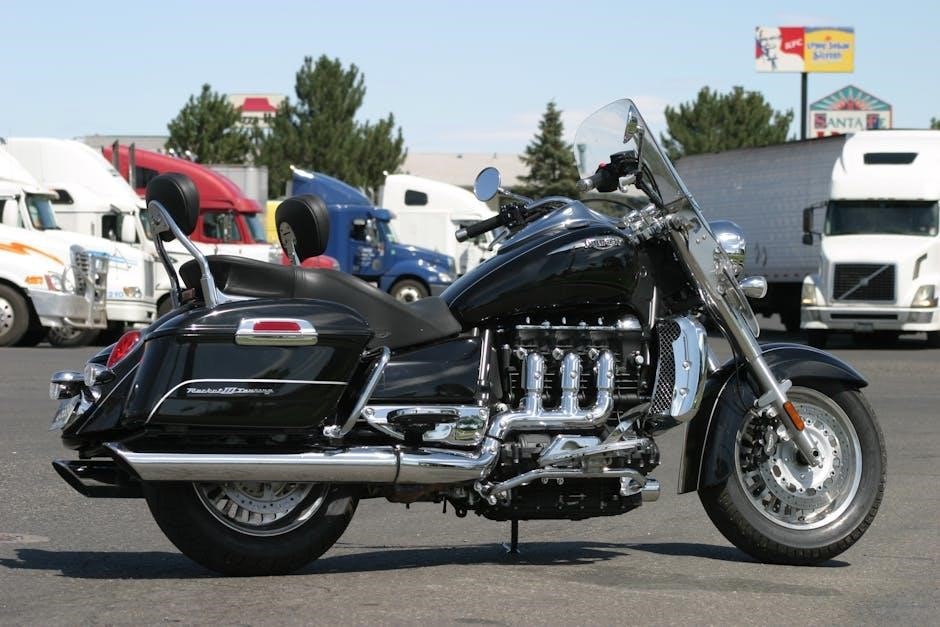
Harley’s Street Bob, equipped with a 1923cc engine, requires precise torque specifications detailed in service manuals and readily available torque charts.
Street Bob Engine Torque Specifications
Harley-Davidson Street Bob engine torque specifications are crucial for optimal performance and longevity, demanding meticulous attention to detail during maintenance and repair. Accessing accurate torque values is simplified through dedicated service manuals, the official Ready Reference Torque Value booklets (Part No: 99959-14), and comprehensive online databases.
These resources provide specific torque settings for various engine components, ensuring proper assembly and preventing potential damage. Utilizing these readily available PDFs and charts guarantees correct tightening procedures, contributing to a reliable and enjoyable riding experience. Always consult the most current documentation for your specific Street Bob model year.
Downloading and Using Harley Torque Specs PDFs
Reliable sources offer Harley torque specs PDFs for easy access, enabling organized libraries for convenient maintenance and repair reference during motorcycle work.
Reliable Sources for PDF Downloads
Finding accurate Harley-Davidson torque specifications in PDF format requires utilizing trustworthy sources. Official Harley-Davidson service manuals, available through their dealerships or online parts retailers, are the most dependable option. Several online motorcycle forums and communities dedicated to Harley-Davidson often compile and share torque charts and PDFs, but verifying their accuracy against official documentation is crucial.
Beware of unofficial websites offering downloads, as these may contain outdated or incorrect information. The Harley-Davidson website itself may offer limited downloadable resources. Prioritize sources that clearly state the year and model of the motorcycle the specifications apply to, ensuring compatibility and preventing potential damage from incorrect torque values.
Organizing Your Torque Specs PDF Library
Efficiently managing your Harley-Davidson torque specs PDFs is vital for quick access during maintenance. Create a dedicated folder on your computer or cloud storage specifically for these documents. Subdivide this folder by motorcycle year and model – for example, “2023 Street Bob Torque Specs” or “Evolution Engine Torque Charts”.
Consistent naming conventions are key; include the year, model, and a descriptive term like “Torque Specs” or “Service Manual” in each filename. Consider using a PDF reader with bookmarking features to navigate directly to specific sections within larger service manuals. Regularly back up your library to prevent data loss and ensure continued access to critical information.

Safety Precautions When Applying Torque
Always utilize the correct torque wrench and avoid over-torquing, which can damage components. Proper tool usage and careful attention to specifications are crucial.
Proper Tool Usage
Selecting the appropriate torque wrench – clicker or digital – is paramount for accurate results. Ensure the wrench is in good working order and calibrated regularly for precision. Always use the correct socket size to fully seat on the fastener, preventing rounding. When applying torque, pull smoothly and steadily on the wrench handle; avoid jerking motions. Understand the wrench’s scale and units (ft-lbs, Nm, in-lbs) to avoid errors. Never use cheater bars or extensions unless specifically accounted for in the wrench’s calibration. Prioritize using a torque stick when appropriate, following manufacturer guidelines.
Avoiding Over-Torquing
Over-torquing fasteners can lead to stripped threads, broken bolts, or damaged components on your Harley-Davidson. Always double-check the specified torque value in your service manual or a reliable torque specs PDF before applying force. Stop applying pressure immediately when the torque wrench indicates the target value is reached – do not continue. If conflicting values exist, err on the side of caution and use the higher specified torque. Regularly inspect fasteners for signs of stress or damage. Remember, proper torque ensures a secure connection without compromising component integrity.
Utilizing accurate torque specifications, readily available in Harley-Davidson service manuals and convenient PDF resources like the 99959-14 booklet, is paramount for long-term motorcycle health. Consistent application of correct torque prevents component failure, ensures rider safety, and maintains optimal performance. Regularly referencing these guides during maintenance and repairs safeguards against issues stemming from under- or over-tightened fasteners. Investing in quality torque wrenches and understanding proper usage further enhances reliability. Prioritizing correct torque is a fundamental aspect of responsible Harley ownership and preservation.